Lumber trading / Founding design

Vantage LumberFrom zero to one.

Turning a complex physical trade into a connected, AI-assisted workflow.

0 → 1

From founder’s vision to product POC

One trading cycle. Two starting points. Shared context from deal to payment.

MY MANDATE
Founding product design · workflows, interaction & system
TEAM
Direct collaboration with non-technical stakeholders
STAGE
0 → 1 · proof of concept

01The starting point

A trade is more than a buy and a sell.

Vantage’s ambition was to bring physical lumber trading into one connected product. Traders needed to move between mill supply, customer demand, inventory and transport without rebuilding the same deal at every handoff.

As founding designer, I translated that ambition into a proof of concept with an explicit operating model: who owns each decision, which information travels with an order, and where a person must review the next action.

02Translating business expertise

Direct conversations. Concrete product decisions.

01 / Make the business model explicit

“Sell this load” changes meaning depending on its origin, destination and ownership. The model distinguishes direct trades, open To Sell / To Buy positions and reload inventory. Routing also changes how profit is allocated.

02 / Discuss a trade, not an abstract feature

A concrete order makes requirements easier to discuss: which mill branch supplies it, what the customer yard can receive, how the tally is priced, and who handles freight and invoices. The interface gives business experts something specific to correct.

03 / Turn the answer into a reusable rule

Customer product preferences and delivery constraints become structured data. Shared configuration, explicit statuses and documented use cases carry those rules into offers, orders and handoffs. This is the foundation an automation layer can act on.

03Defining the first product

Two ways into a trade. One connected lifecycle.

The POC joins the commercial journey end to end. A purchase order (PO) records supply; an order confirmation (OC) records a customer commitment. Either can come first.

Fulfill a customer request

  1. Capture demand in an OC: product, tally, customer yard, delivery terms and target timing.
  2. Source through a direct purchase, the To Buy list or available reload stock; preserve the customer’s requirements.
  3. Link supply to the order, arrange freight, track shipment and carry the same context into invoicing.

Sell out of a mill

  1. Configure mill supply, origin, equipment, product and price; prepare offers or create a PO.
  2. Match customer demand and delivery constraints; sell directly, publish to To Sell or route into a reload.
  3. Create the matching OC and continue through dispatch, invoice review and payment status.

The POC boundary

The product vision includes advanced AI automation. The designs demonstrate its operating foundation and human review points; they do not establish that autonomous trading was deployed or that AI accuracy was validated.

04The hard parts

Four hard problems.
One coherent experience.

01 / Challenge

Make the right match before making the trade.

TENSION

A match depends on more than species and size. Grade, lengths, pack configuration, customer yard, rail access and delivery terms all affect whether a load can actually be sold and delivered.

MY DECISION

I connected CRM product-fit criteria to offer generation. Mill, inventory and customer-based offers share a configuration model. The interface surfaces matching demand, nearby customers, destination choices and a price breakdown: base price, transport and adjustment.

WHY IT MATTERS

The trader can review the commercial and logistical fit together instead of reconstructing it for every customer. The trade-off is more structured setup in CRM, so later recommendations have useful inputs. Matching remains a reviewable suggestion, not a commitment.
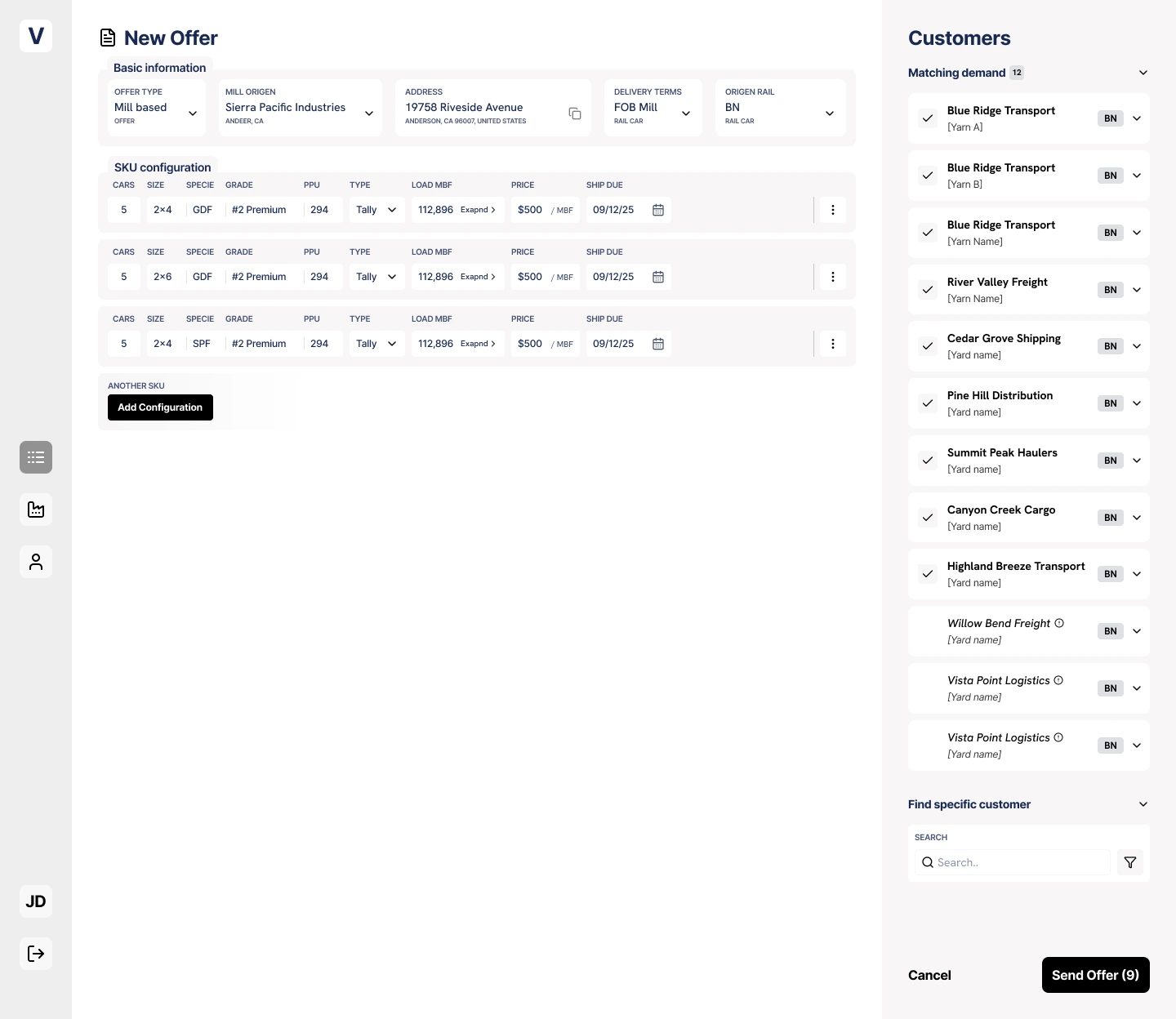
Mill-based offer: configure supply once, then review matching customers and yards.

02 / Challenge

Scale the work. Keep each line visible.

TENSION

A multi-car deal should not require the trader to repeat a complete form for every order. But applying one value indiscriminately can spread an incorrect price, tally or delivery date across the entire batch.

MY DECISION

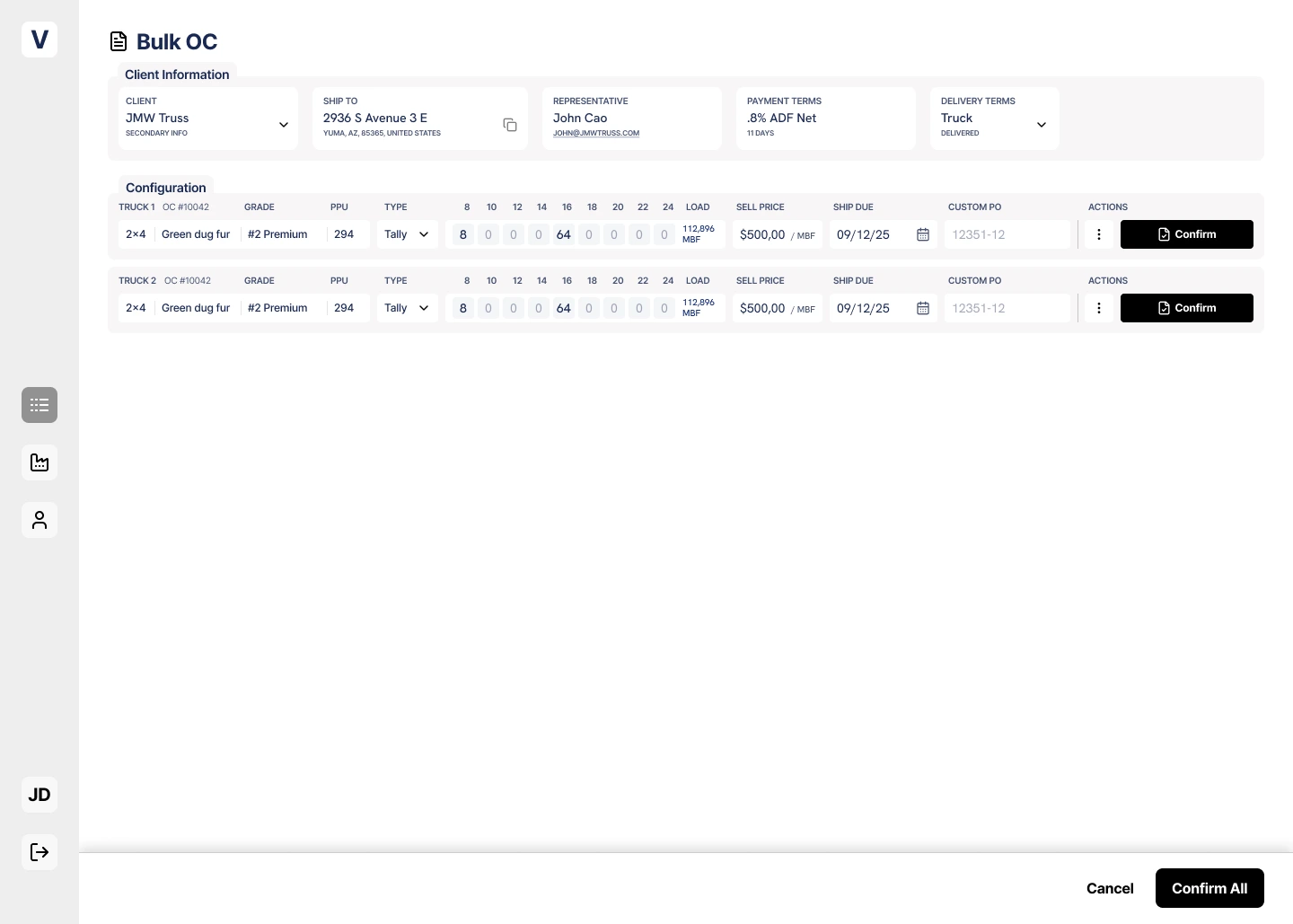
I separated shared customer or mill details from per-load configuration. Batch Buy, Batch Sell and Bulk OC keep individual rows editable and pair per-row confirmation with Confirm All. My Tally brings lengths, remaining units and buy/sell calculations into the path to generating a PO.

WHY IT MATTERS

Repeated setup becomes one shared step while the differences that define each trade remain inspectable. Bulk invoice generation extends the same approach into finance. The benefit is fewer repeated interactions; the POC still needs validation for partial failures and conflicting updates.

Bulk OC: shared client details, separate load rows and an explicit final confirmation.

03 / Challenge

Make automation safe to question.

TENSION

Automation can move an incorrect reference, tally or date through the business as quickly as a correct one. Finance needs to understand where a mismatch comes from before accepting an invoice.

MY DECISION

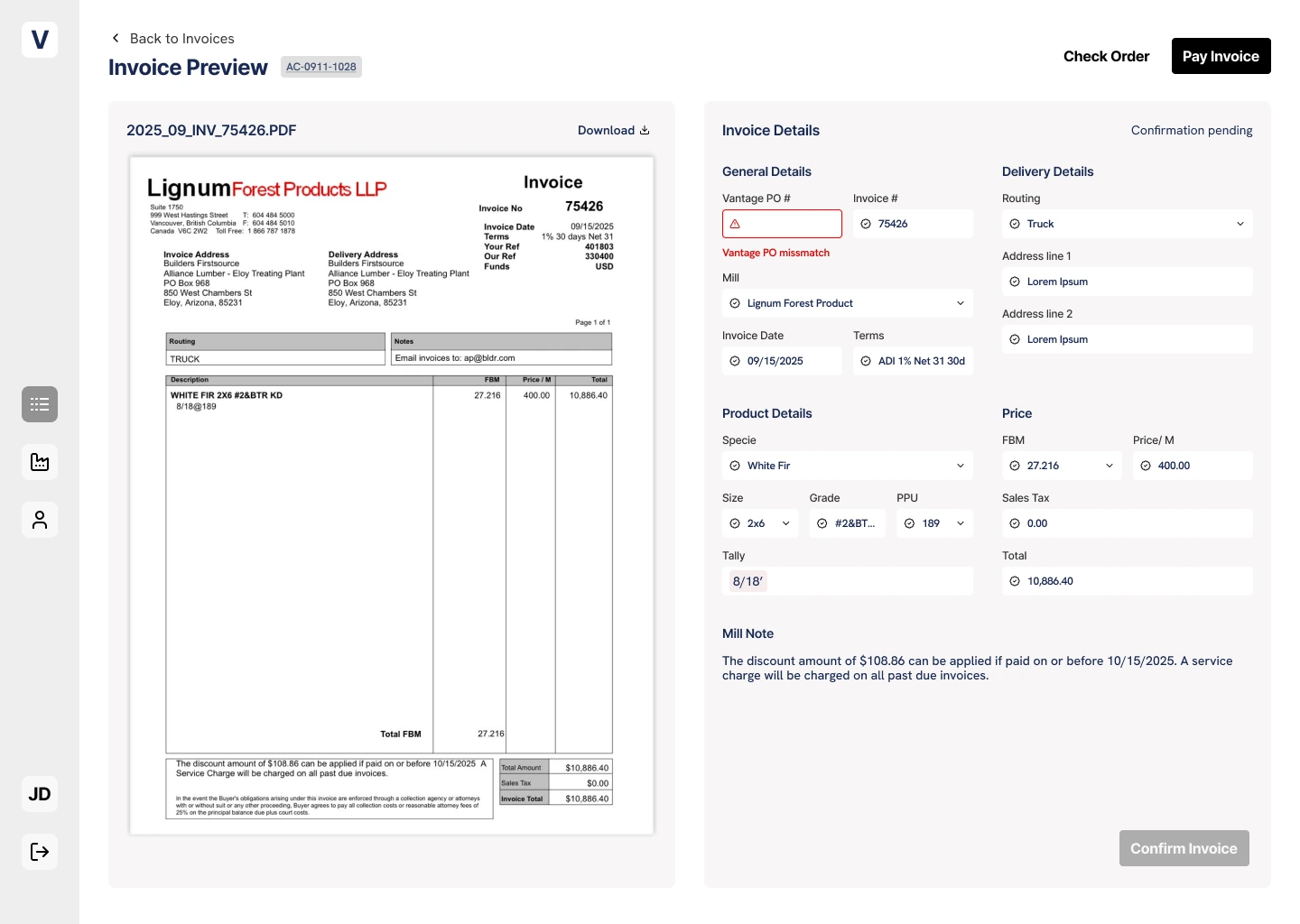
I made review a visible part of the workflow. Invoice Preview places the source document beside structured fields, flags a PO mismatch and shows confirmation pending. Attention Needed queues separate exceptions from routine work; linked order details and history supply the context to investigate.

WHY IT MATTERS

The POC establishes a human review surface for automation: inspect the source, understand the exception, check the order, then confirm. This supports the AI ambition without asking users to trust an unexplained output. Extraction accuracy and exception handling remain validation work.

Invoice mismatch state: source evidence, structured fields and a disabled confirmation.

04 / Challenge

Check the economics. Then commit the load.

TENSION

A single load contains multiple lengths and pack quantities. A headline price hides the calculation behind it, while unavailable stock or an overlooked freight charge can change the commercial result.

MY DECISION

My Tally keeps print, cost and sell prices beside units by length, remaining quantities and an inventory snapshot. Negative balances are visually distinct, and selected configurations lead into PO creation. Elsewhere, cost breakdowns separate freight and fees from the buy/sell spread.

WHY IT MATTERS

The trader can inspect the assumptions before generating the order. This is error visibility rather than a promise that every invalid trade is blocked. The design also makes routing-dependent commission splits explicit, keeping trader allocation separate from the trade’s overall margin.

05Foundations that could grow

Shared data. Role-specific work.

TRADERS

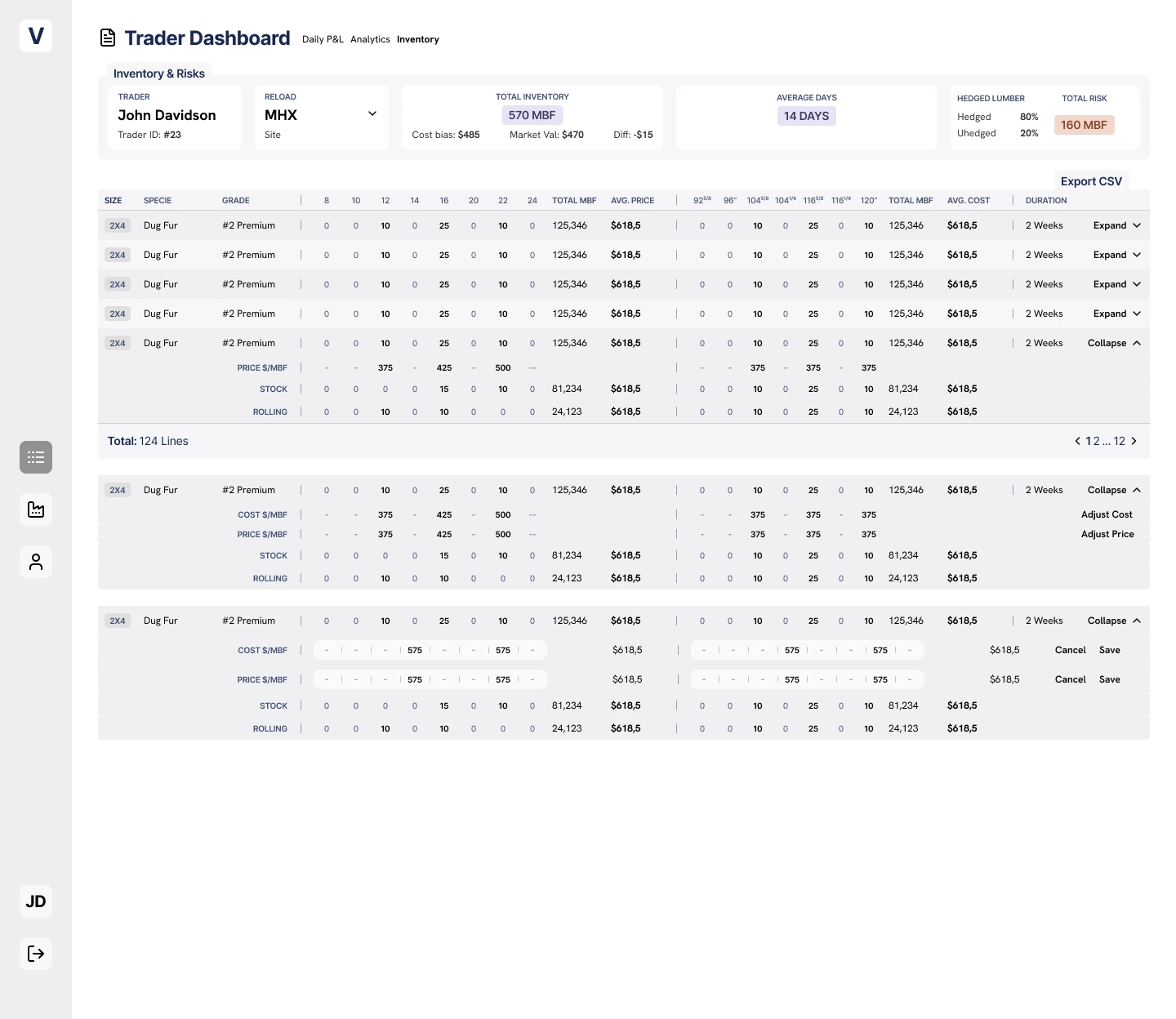
Configure and price loads, match supply with demand, create POs and OCs, and review open positions. Inventory views distinguish stock from rolling supply and expose cost, sell price and age.

TRANSPORT MANAGERS

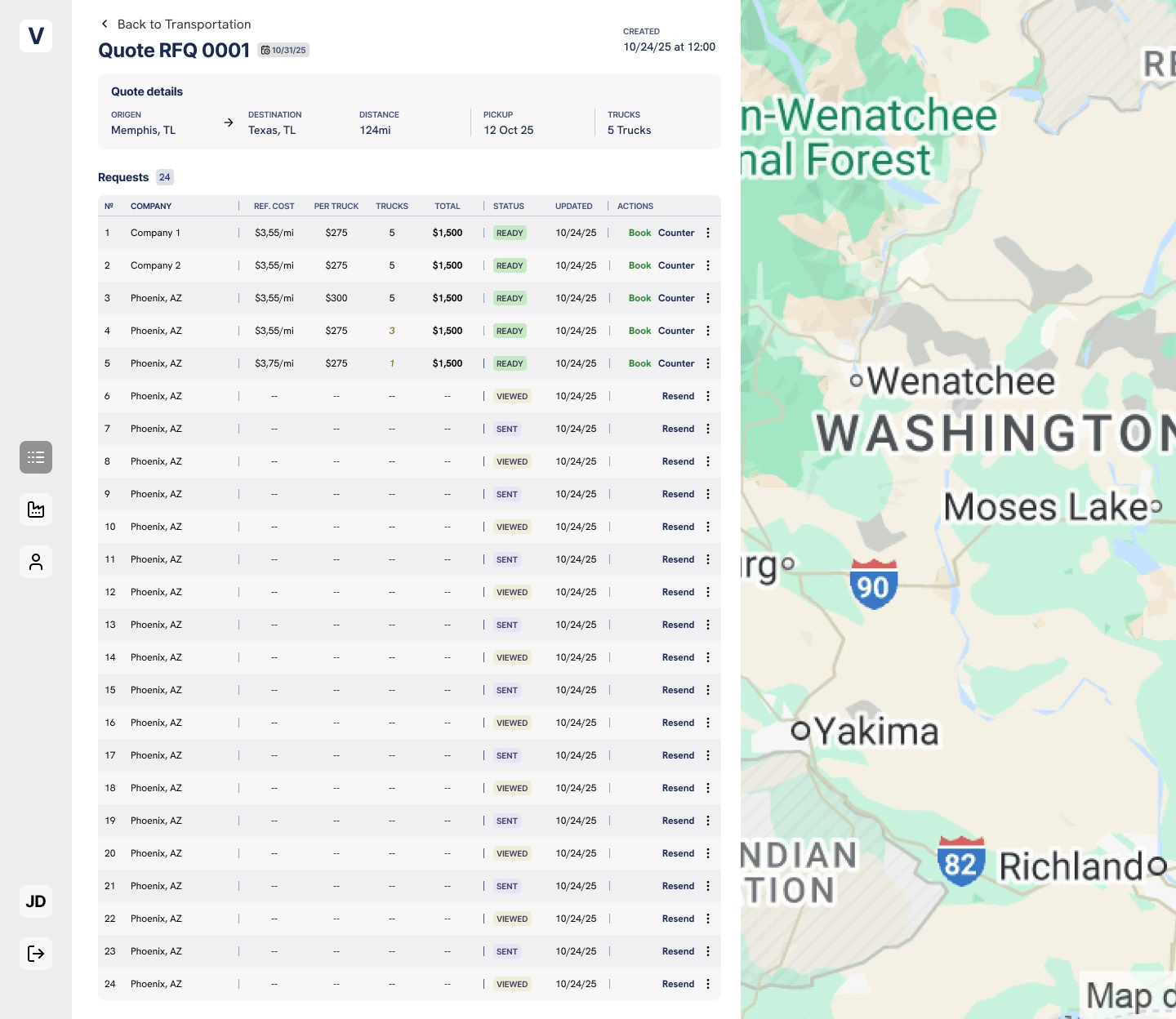
Send RFQs to selected companies, compare rates and truck availability, counter or book, then link OCs to dispatch. Pickup and delivery details remain part of the same operational handoff.

FINANCE ADMINS

Review AP mismatches, generate AR invoices in bulk, track payment and overdue states, and inspect margin and fee breakdowns. Role-specific notes and history preserve accountability.

CUSTOMER-LED

Customer request → OC → Source supply → Linked PO

MILL-LED

Mill supply → PO / Offer → Match demand → Linked OC

SHARED COMPLETION

Transport & dispatch → Shipment → AP / AR → Payment status

One domain model connects product, counterparty, order, shipment and invoice. Reusable cards, inputs, filters and status patterns keep that model consistent across roles.

06The working system

Designed around a trader’s day.

The trader dashboard brings inventory, rolling supply, prices and risk into the same view. It supports the next decision rather than making users gather context from several disconnected records.
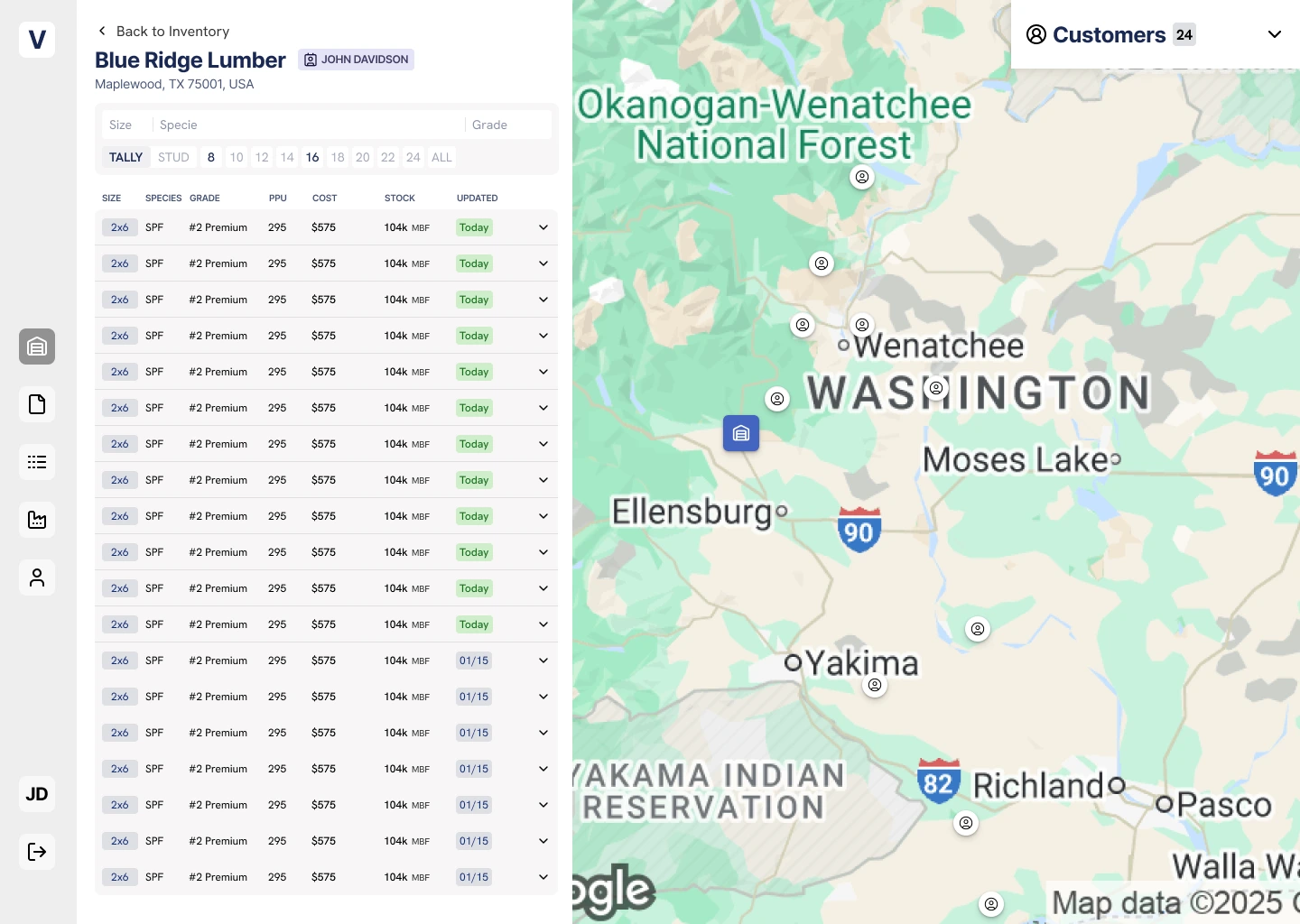
Inventory: connect available stock with nearby customers and demand.
Transportation: compare carrier responses in the context of a route.

07What the POC established

DESIGN OUTPUT

A connected POC

A coherent experience across trading, inventory, transport and finance, with both customer-led and mill-led entry points.

Evidence: linked designs and full-flow walkthroughs.

INTENDED VALUE

Less re-entry

Shared configuration, bulk actions and linked records are designed to reduce repetitive work and expose exceptions earlier.

Time savings and error reduction are not yet quantified.

FOUNDING CONTRIBUTION

A common model

I turned specialist business knowledge into visible rules, reviewable interactions and reusable patterns for a growing product.

Evidence: use-case notes, component library and role workflows.

Clarity before autonomy.

The hardest 0 → 1 work was translating a business expert’s mental model into a system that other people could understand and operate. Making exceptions visible is as important as accelerating the happy path. A convincing POC is the beginning of validation, not proof of production reliability.

What I would validate next

Run both journeys with traders, finance and transport staff. Measure time per batch, repeated field entry, mismatch detection and correction effort. Stress-test stale stock, conflicting edits, partial confirmations and uncertain AI outputs before expanding automation.

Founding design / Vantage Lumber

Make complex work
clear enough to trust.